Showing posts with label parenting. Show all posts

Friday, January 24, 2014

Word of the day: Lapse


lapse

 noun \ˈlaps\
: an occurrence in which you fail to think or act in the usual or proper way for a brief time and make a mistake
: an occurrence in which someone behaves badly for usually a short period of time
Source: Merriam-Webster.com 

Years ago one of my daughters neglected to do something she should have, and ended up in a bit of a mess. As she wailed about her situation she finished with the moan, "...and now you'll never trust me!"

The good part, of course, was that she clearly wanted to be trustworthy. The funky part was the blanket statement. Never?

"Oh, my," I said, as gently as I could, "There are many things I can trust you with. I trust you to choose good friends, I trust you to be basically truthful, I trust you to brush your teeth at night, and I trust that you want to do the right thing here. The fact that you didn't do this one thing doesn't mean you're a total failure, or that you're completely untrustworthy. It means that in this one area you had a lapse of judgment, and in this one area we need to do some work."

Blanket statements can be smothering, yet we all make them at times. After I snarl at a child, I throw on the blanket statement that I'm a bad mother. The truth is that I'm not a bad mother; probably all that happened was that I had a good-mommy lapse. After forgetting something important on my to-do list, I may throw on the blanket statement that I'm an idiot. And yet I'm not an idiot, I've had a memory lapse.

Remembering to draw a distinction between an incident about which I feel bad and a perpetual state of being is huge. If I label myself as a failure, a fool, stupid, irresponsible, a bad parent, or lazy, I attribute a permanence to a behavior that isn't actually justified. What's more, once a label is in place, confirmation bias takes over. Confirmation bias is that "I think A, therefore I start to notice A all the time" thing that happens to all of us. The problem is that when we start seeing A, we tend to stop seeing B. If we label ourselves as, say, a failure, then we become more aware of every event which confirms our opinion, and we overlook information that would disprove (or at least balance) it.

Similarly, if I decide that someone is a jerk, chances are that he or she could change for the better and I wouldn't even notice. I'd be too busy noticing every negative thing that person does.

There are people whose pattern of behavior is so pervasive that it's almost impossible to avoid concluding that the person is, in fact, a jerk. But the odds of getting that person to stop acting like a jerk go way up when we notice his or her occasional non-jerky behavior, comment upon it, and thus reinforce the good.

If we want to be better parents, or to at least have a shot at becoming better human beings, it's worthwhile to learn to pay attention to when we berate ourselves. If you wouldn't let someone else talk to you the way you talk to yourself, STOP. Feel bad for a while, but remember that most of the time, in most situations, you aren't the bonehead you've just accused yourself of being.



Tuesday, December 17, 2013

The Green Blocks approach to life


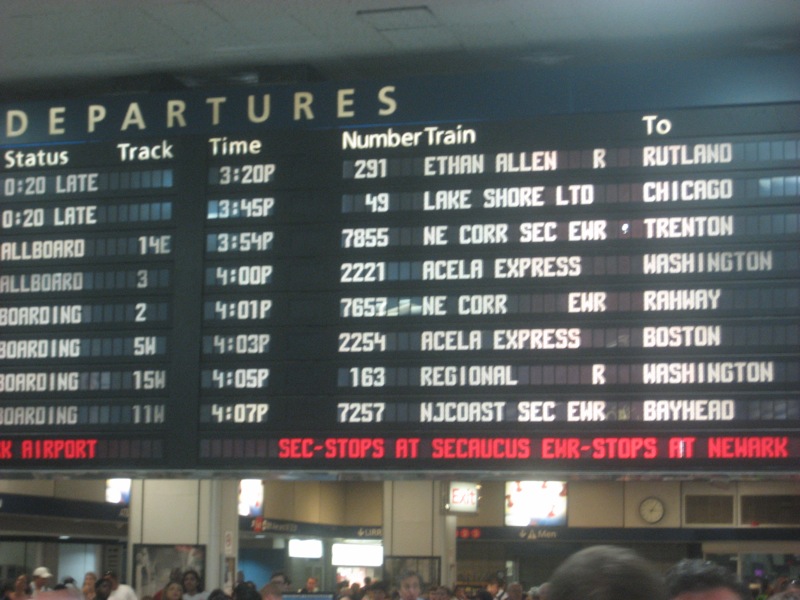
Coming home Sunday night from the final performance of Honk! (featuring Little Guy in his first lead, and Snuggler in a main character role) I had a mental image of the departure board at Penn Station, with the top listing flicking its way off and all the other train listings moving up a notch. It's not a bad analogy for my life at the moment. Dancer finished her first weekend of Nutcracker performances, and now has only four more to go (I work backstage for most of that). Eldest arrives home on Wednesday. Our annual cookie project is concluding, in which folks from the neighborhood bake cookies which then get delivered to the local food pantry. My mom arrived Sunday morning so she could see the musical; she leaves today, weather permitting.

Ten days (or departing trains?) ago, during my intense busy period of editing six masters' thesis proposals (which coincided with a quarterly project and a monthly project), Eldest hit a crunch: she had three huge school projects due and a trip to California for a job interview. It was an overwhelming to-do list even by my standards.

The situation looked impossible from every angle. Which, however, did not mean it was impossible. We tend to think things are impossible long before they are. And once we start to fear something is impossible, anxiety can easily take over space in our brains that could and should be allocated to actually solving the problem.

Sometimes fear is a bigger obstacle than the actual problem, because fear can paralyze. As soon as you are paralyzed, you can almost guarantee you won't get through whatever it is you have to do. Which is why I live by Winston Churchill's saying, "If you're going through hell... keep going."

I have a method for dealing with impossible situations: I call the Green Blocks approach to life. When my kids were little and made a mess, saying, "Clean up this room!" was less than useless, because the directive was too overwhelming. So instead I'd say, "I need you to pick up all the green blocks." That narrowed the project down to one thing to focus on, and made it do-able.


After the green blocks were put away, we switched focus to the yellow blocks. Then the red blocks. The idea was to do one thing at a time. Whatever was next wasn't even on the to-do list until the first task was done.

In a way this is the antithesis of multi-tasking. Do one thing, and do it with 100% focus and effort. You will have more brainpower to put into it, and you will make progress. Then the problem becomes smaller.

*         *         *          *


Worries will creep in anyway, of course. I manage that by setting a specific time when I will allow myself to worry about the next thing. Maybe it's two hours away, or maybe at 8 p.m.  As I told Eldest, it's okay to set aside a worry for a while -- it's not as if it's going to go away if you put it down. When your allotted time for the task at hand is up, you can pick up the worry again... if you want to.

*          *           *          *

When you were a kid, hyperventilating at a page packed with 50 math problems, hopefully your teacher showed you how to put a sheet of blank paper over all but the first line, so the task wasn't so overwhelming.

As adults, we sometimes forget that we can still take this approach to big problems. The more successful we are at developing techniques that keep us from becoming overwhelmed, the more likely we are to succeed in getting through the big things. 

You can only do what you can do. Then again, you can do far less when you're feeling overwhelmed. You can do far less when you're worried. You can do far less when you're floundering or running in circles. 

Even if all you can do is put away the green blocks at the moment, do it. If you can't pick them all up, pick up five. Then pick up five more. Or map the number that you pick up to the digits in your phone number (e.g., first pick up 2, then 1, then 2...)  It's not nearly as hard as trying to pick it all up at once.  


Friday, November 22, 2013

Social responsibility

I was at a social event a while back, outside of my neighborhood, with people I sort-of know but don't know well. It was a small gathering.

At one point I was talking about Eldest and her job search (she's a senior now), and how she wants to put her computer science degree to use in a position where it would make a difference in the world. She's not interested in working in finance, and not interested in start-up shopping services, and not interested in designing violent computer games. She's looking at companies at the intersection of computers and education, and at firms that build computer games that improve health outcomes, and at places that make applications to accelerate relief services after natural disasters.

One of the women turned to me and asked, "How do you teach a kid that kind of social responsibility? Kids feel so entitled these days!" Then the doorbell rang, so I didn't get to answer.

*        *         *         *

Had I had the chance to reply, my reply would have been, "You can't teach social responsibility... you have to live it." I would have also said that there's no guarantee. I don't know what proportion of what parents teach their kids gets tossed out; I've always guessed it's about 30%. It's probably a different 30% for each kid, too. Kids make their own choices, and some of them will end up having values very different from ours.

All we get to choose is the input. This one of the things I think many parents struggle with mightily: even if we do it all "right", at best we influence rather than control the outcome.

We're also notoriously blind to our sins of omission. What we teach our kids consists not only of what we say is right and wrong, but by what we show them. We can assume our children know we believe we should take action to alleviate human suffering, but they don't see what happens in our heads. They don't even see the check we put in the mail for typhoon relief. If we remember to tell them about the check, we forget that they don't necessarily know a) the thought process that went into our decision, b) whether the amount we sent constitutes a real sacrifice or simply an allocation of funds, or c) what our role is in alleviating suffering in the world.

We may forget to talk about how suffering is a constant for many people, not a weather-driven exception. We may forget to muse aloud about how hard it is to remember that others suffer, and how hard it is to remember -- in the midst of thinking about what we'd like to eat for dinner -- that we are the means of making the lives of others better.

When someone else's extreme suffering intrudes on our feelings, we have social sentiment. Social responsibility is what we do day in and day out.

*         *          *         *

I think it helps not to have extra money to donate to causes. Kids, after all, learn by doing, not by writing checks.

They learn by shopping for the food pantry ("Let's buy the good stuff, because think of what a bummer it would be if you had to go to the food pantry for Thanksgiving dinner supplies. And think how happy you'd be to see something really yummy in your bag!")

They learn by coming with you when you deliver the meal to the mom with a newborn. ("I betcha Sam's mom is exhausted. So I made them supper to make her day a little easier.")

They learn by having to deal with your absence when you're at a community board meeting, or when you shlep them along to put up fliers for an event, or when you send them on an errand to help a neighbor.

The main thing is that they get the picture by connecting the dots... and there have to be a lot of dots for the picture to make sense.

Monday, September 2, 2013

Thoughts on feeling that you can't make ends meet

There is nothing quite like cleaning a kid's room to re-realized how not-poor you are. I was thinking about it this way:

On the left side of the scale let's put all the things you want for your kids, as well as the desires (for them and for you) that you think of as needs.

On the right pile let's put all the waste: the carelessly broken, unused, good-for-a-week, and no-longer-of-interest toys and games; the leftovers that went bad in the fridge and the food thrown out partly eaten; the collection of single earrings mourning their mates; the clothing that is perfectly good but languishes unliked and unworn in dresser drawers.

It puts some perspective on all those desires, doesn't it? Because all that stuff you're throwing out was once, in some way, desired.

*         *         *          *


I tell my kids they have the right to feel poor on the first day they don't get to eat.

I don't expect them to buy it completely, of course. We all feel poor when others have things we can't afford. We feel poor when we have to work hard at making ends meet. We feel poor when we have to make hard sacrifices and trade-offs. We feel poor when we can't replace things we're used to having, and when we can no longer afford to do things we used to be able to do.

Whether feeling poor is the same as being poor is a different issue. The yardstick doesn't begin with where we are and end with where we want to be. The yardstick begins with poverty we can't imagine, and ends with wealth we wouldn't enjoy. How much of it we see is up to us.

*        *         *         *

A dozen years ago I met someone who managed to scratch three meals out of one chicken for her family of four. I knew how to get two meals for my then-family of five, but was baffled by the third. "Soup," she told me, "I never buy chicken without making soup."

It had never occurred to me to make soup from the scraps. At first it seemed like a ridiculous amount of extra work. But like most things, it doesn't take that much work once you make it part of your routine. It's like baking muffins: less expensive than cereal, better for you, and five minutes to mix up and toss in the oven. Simple. Sometimes we're poorer because we lack the insight to see how much more we can do with what we have.

*          *          *           *

One reason we sometimes feel we don't have enough for our needs is because as soon as we have resources our minds revert to thinking about what we want, instead.

It also think that, aside from being incredibly bad at distinguishing our own needs from wants, we confuse others' needs with what we want for them. This is true when it comes to our kids, and particularly true when it comes to things that we think will make them happy, smart, engaged, interesting or better able to capitalize on their innate abilities.

I hit this wall every year, when I try to reconcile our homeschooling activities with our budget. It is hard to see what would be beneficial but isn't possible. Eventually, every year, I shrug. I can't do everything I think would be beneficial, because that's not one of my options. Instead I do what I can with what I have, and trust that somehow that will grow into what it needs to be.


Saturday, June 15, 2013

A small insight about why kids don't share everything with mom

I observed a mother and her teenage daughter interacting the other day, and suddenly understood why kids can tell total strangers the secrets they won't tell their parents. It's because our kids love us.

When our kids love us, they don't want to hurt or disappoint or worry us, or have us think less of them. And they know that no matter how good a face we put on it, deep down we have a reaction. When a child is hurting, he or she can't afford to deal with our reactions on top of that.

That is why a parent can't be a child's therapist or complete confidante: because love gets in the way.

We will always know our children better than anyone else. But a child can count on a professional to be impartial. There's no risk of losing desperately-needed approval and affection. Which means that sometimes the reason kids don't confide in us has nothing to do with lack of trust, but with an abundance of love.

Sunday, March 17, 2013

Priorities, the hard way

Big Guy has been doing well for some time. We have not had to even think of calling 911 for over six months. And then on Thursday we had to make a call.

Four large policemen arrived. We discussed the situation, and agreed that based on the incident that triggered the call, Big Guy needed to be evaluated by a professional. So they summoned the EMTs, and off Big Guy went to the ER. Andrew went with him.

I've BTDT so many times that the first thought in my head was, "Okay, so for now everyone is safe."

That is how parents of kids like mine think. But not at first. The last time I was at the psych ER I spoke to a mom whose daughter was being admitted and said, "I know you feel like the biggest failure in the world right now, but you are awesome. You have done the very best thing you could do for your child, because right now she is SAFE. And whatever anyone thinks or anyone says, what you need to tell yourself over and over again is, my child is safe."

Despite the positive framing, there are things that are so not okay. While Big Guy was blowing up, Snuggler curled on the sofa, tears running down her face as she moaned, "Not again! Oh, no, not again!"

Little Guy screamed and ran into the bedroom and hid himself under the blankets. "No! No'! No!" he cried, "I don't want anyone to die!"

And I couldn't help them, because I had to focus entirely on managing Big Guy. Safety. Safety. Safety. There is a point where the whole world, the whole list of priorities in life reduces to safety.

I was very proud of Snuggler, who after a few minutes pulled herself together and, of her own accord, went in to solace Little Guy. Later she said, "It helped me, too, Mama. When you have to calm someone else you need to calm yourself first." That takes a degree of courage and insight that's unusual in an 11 year old.

After the police arrived and we were on safe ground again I packed up my two youngest and took them off to Dancer's dress rehearsal. I'm sure that sounds weird, but after a crisis my #1 priority shifts from safety to security, security, security. Oh how, oh how, oh how do you give a sense of security to children who have to live in an erratic and sometimes dangerous situation? How can kids grow up healthy when things can shift from safe to scary in a moment? One gives snuggles and hugs and love, and tries to keep life feeling as normal as possible. We make time and space in which to remember that this one event doesn't constitute the whole of our lives.

A delayed stress reaction hit Snuggler as we arrived at the theater. We had a bit of waiting time, so we hung out in a corner as she whimpered that she was scared. We played hangman, talked about school, waited in line. We watched -- and greatly enjoyed -- the performance. Dancer was stunning. When we got home at about 10pm, I emailed Snuggler's teachers to say they shouldn't expect to see any homework the next day.

Then Andrew called to say Big Guy had been deemed safe and was being sent home. Getting the others to bed, and more importantly to sleep, shot to the top of my priority list. Because, you see, it's hard to get to get a scared kid to sleep. Now my mantra was calm, calm, calm.

I washed dishes, talked to kids, got them to bed. Little Guy slept in the girls' room on the top bunk, "Because my brother won't find me up there." Snuggler opted to drift off in the living room, listening to an audio book.

Big Guy and Andrew arrived at midnight. Big Guy was exhausted and went straight to bed. The day was over. The next day (and perhaps for the next week or month) we'd most certainly see fallout, but it would be a new day. That wasn't today. I said my prayers, and went to sleep.

One of my favorite quotes is from Winston Churchill, who said, "When you're going through hell... keep going."

It's easier to keep going if I have my priorities in order. Be safe. Stay calm. Find the things that help you feel secure. Remember not to let the bad things become everything. Pray. And keep moving forward, at whatever tiny pace you can muster.  


Thursday, March 14, 2013

Identifying problems, part II

Part one of this post is here.

If I had to make a Top 10 list of parenting skills, the ability to step back and shut up would rank somewhere near the top. Not that I've perfected the skill, of course. But when I do remember to practice it, it does tend to promote sanity, peace, the ability to retain some semblance of self control, and better relationships with my kids.

Learning to shut up is hard. It's hard because we want to be right, we want to have the last word, and on top of that our inner 8-year old imagines we're engaged in a long-ago argument with a sibling.

Another reason it hard to bite our tongues is because we've spent years instructing and correcting and being a frontal-lobe enhancement for our kids: we're in the habit of teaching them. And although we continue to instruct as kids get older, we need to do it in a different way. I think this is because two things happen around the time they are nine or ten.

The first is that -- for most things -- kids already know right from wrong. So when they do wrong we're not dealing with ignorance any more, but with something else. Like what, you ask? Oh, insecurity. Impulsivity. Immaturity. An emerging desire for independence. Self indulgence. Memory blips. Failure to apply a general concept to a specific situation. Hormones. And, of course, rationalization. (Even we adults are good at that. For a fun and interesting read, try Dan Ariely's The Honest Truth About Dishonesty.)

I don't know about you, but I get annoyed when someone tells me something obvious, especially when they imply I ought to know it but was too stupid to remember. Kids feel the same way. They  especially feel this way once they're old enough to realize they know everything and you know nothing. And this is true even when they've just demonstrated, clearly and completely, that they have not integrated the information they know into their behavior.

The second thing that happens when kids get toward tweenage is that we need to shift toward getting them to think through problems on their own. One of the best skills we can give our kids is the ability to analyze a situation and think before they act. But it's a learned skill, not one that they grow into automatically.

How do you teach without lectures? By asking more questions and making fewer statements. We don't need to ask the obvious question ("What were you thinking?") but to give kids prompts that will get them thinking. What will happen if you...? How do you think she felt? Is there a difference between what you want to do and what you should do? Why does what he says matter to you?

You may recall that the first item on my list of 15 Things I Know about Parenting a Difficult Child is this:  You can't always make it better, but you can always make it worse. I'm able to make things worse pretty quickly if I let myself misdiagnose the cause of conflicts with my kids as their inability to listen, rather than my inability to hold my tongue. Both are contributing causes, of course. But I'm the one responsible for what comes out of my mouth. It makes sense to start there.


Sunday, March 3, 2013

Resources for parents of kids with "issues"

One of the wonders in my life is an email list for parents of kids who are bright but have "issues". I've been on that list for years, and believe me: it helps to have a group of BTDT people to turn to when you're baffled, frustrated, worried or need advice about something you don't want to tell your neighbor. They're the ones who taught me to put on my own oxygen mask first, who have recommended helpful books on learning disabilities and how to deal with an emotionally inflexible child, and who know a lot about how to advocate for services.

The other day two things came through. The first was Kveller's post on Ten Things I Wish Someone had Told Me About Parenting a Special Needs Child. The second was a link to the Centre for Clinical Intervention site, which has free workbooks online. The topics covered include panic attacks, perfectionism, procrastination, social anxiety, excessive worrying, distress intolerance, and more. It's not the same as getting actual help, but not a bad place to start if you're trying to figure out what kind of help your child (or you!) need with a particular issue.


Thursday, February 14, 2013

Identifying problems

One of the cardinal rules of parenting is that if you want a child to change his ways, you have to make the problem his problem. You see, if Mom doesn't like a messy floor, that's Mom's problem. And if you think your kid is going to volunteer to solve your problems, you are almost certainly wrong.

Another cardinal rule of parenting is that if you, the parent, are feeling perpetually frustrated by a recurring kid situation, chances are that you are owning the kid's problem. A recent example: Child A fusses and moans and delays doing homework. I encourage/remind/berate until, after weeks of this, I am worn out and annoyed and am no longer acting like the Mom I Want to Be. Fact: on some level this child is smarter than me. He or she has figured out how to transfer ownership of the problem by re-defining it from being about homework to being a matter of Mom and her temper.

How did that happen?

Partly it happened because there are very good reasons I want this child to do homework. It's in his or her long-term interests (I have a goal of having the child develop good work habits and perseverance), and it's also in his or her intermediate-term interests (I know grades affect other prospects). It's also in my short-term interest to make sure the homework gets done, because this particular child becomes frantic when suddenly it's time to leave for school and the work is unfinished. Then I have to endure the meltdown and use a pile of energy helping the child manage anxiety.

The child, being a child, has little interest in, awareness of or motivation to work for the longer term. The child, being a human being, has great interest in avoiding inconvenience and work. Result: we have a problem.

When I get stuck in a parenting rut, one of the first things I ask myself is What problem am I facing? It takes some probing, because in all probability the real problem isn't the one I've been addressing. 

For example, there's a huge difference between saying "This kid has to STOP acting that way!" and "I need to teach my child how to overcome procrastination". With choice #2 you can develop a plan to overcome the problem. You can do a Google search on effective strategies to deal with procrastination. You can sit the child down (not at homework time) and talk about how procrastination is adding friction to family life, and why developing ways to identify and overcome it is an important life skill.  You can explain that it's not Mom's job to save the child from the consequences of putting things off, but to teach him skills to overcome the tendency, and help him  practice those skills. And after that you can choose -- heroically -- to swallow your instinctive reaction to roar "Get busy!" and say things like, "Hmmm, it looks to me like you're procrastinating. Are you?" or "Are you keeping track of the time?" You can swallow hard and suppress your urge to nag and say sympathetically, "Wow, you're right: it's going to be scary to go to school without your work done. It's your choice."

If you define the problem as "This child is driving me crazy", you go another route. You will dig your rut deeper, nagging more, imposing draconian punishments, and desperately flinging golden carrots to lure your child to STOP BEHAVING LIKE THAT! You will vent to your friends and spouse, and that won't help. It won't help because you own the problem, and because the problem (now) is your frustration.

Rule of thumb: if your goal is to get someone to stop it! you almost certainly haven't identified the right problem.

Rule of thumb: if your strategy is to nag, you own the problem.

More later...


Wednesday, January 30, 2013

Wading through the pudding of parenting

Yesterday I made tapioca pudding. From scratch, of course; I've never understood the appeal of using a box to save five minutes and lose 75% of the flavor. (Early on in my forays into cost savings I looked at the price of snacks and decided that if I wasn't willing to bake goodies, we didn't need to eat them. Yes, there have been occasions when I've bought cookies, but it's not a regular occurrence.)

So I soaked the tapioca in sweet milk, and went off to do other things. Eventually I remembered to come back and simmer the concoction; I mixed up eggs and let the mixture thicken on the stove, then added vanilla. Half an hour of cooling, then transfer to ramekins. Oh, yum! I covered the ramekins with wrap and put them in the fridge.

After an early supper I took Little Guy to Cub Scouts. My tummy was rumbly on the way home, and I thought happily of the treat awaiting us. When we arrived, Little Guy looked in the fridge and said, "But there's none left! There's only one that's half eaten." I rummaged around and located a ramekin that had been pushed toward the back of the shelf. Then I counted the empty containers on the counter: one, two, three, four... Indeed, the only tapioca pudding left was the one that was half eaten. Someone had taken more than his or her share. Although I was the one who had taken the time to make the pudding, I wasn't going to get to eat any.

The feelings that go through a mom's head at moments like this -- and I assume others have moments like this -- are mixed. There is sadness that one of your own children could be so self-centered. There is a woundedness, too, from having done something generous and getting a punch in the gut in return. There is anger. There is bewilderment. There is disappointment. How can this be?

To eat someone else's share when you've already had an ample portion is just wrong. My kids know this. I know they do. I have taught them, by word and example, to be thoughtful of others. And yet there was half a portion of tapioca pudding instead of a whole one.

No one confessed, of course.

I considered my options. It was a blessing that I was more sad than angry, because often when I'm angry I rant, and that rarely helps anything or anyone. Feeling sad helped me see that the issue wasn't getting the perpetrator know that what he or she had done was wrong. The child knew that, even while savoring my dessert. The issue -- or at least the one I could do something about while my pudding was being digested in someone else's belly -- was honesty. So I gathered the kids who'd been home while I was gone, and said, "What makes me most unhappy is that someone's not telling the truth. I am not going to yell at you. You know I value honesty. I just want to know who ate the pudding."

There was awkward silence. Then one of the children said, "I ate a little bit off the top."

I nodded, ignoring the disparity between "a little bit" and how much was missing.

I thanked the child for admitting the wrongdoing.

I did not impose a consequence, because frankly I am not able to think of something appropriate in the midst of strong emotion, and at that moment I had enough work to do keeping my other feelings at bay.

This morning I decided the fitting response is to require the perpetrator make dessert for the family next week, at his/her personal expense.

And I'm reminded, once again, that the reason to be a good parent is because that's what you are called to be. You can hope to get other things -- like honest and hardworking kids, or the good opinion of others, or gratitude -- out of it. But there are times when what you will get for your effort is a half-ramekin of crusted-over tapioca pudding, and a headache.

That doesn't mean it was a mistake to make the dessert. It just means that I am not, and never will be, the person making the decisions in my child's head.

Monday, December 10, 2012

Uncertainty

At midnight tonight Eldest's two final projects are due. We haven't heard from her in a week; she's pretty much incommunicado in times of stress. I doubt she's had much sleep, and she's a kid person who needs her shut-eye.

A while back I read Dreamland by David Randall, and learned all kinds of tidbits about sleep. There was a whole chapter on insomnia, another on the relationship between sleep and aha! moments, another on apnea and sleep disorders. Apparently the research shows that the number one factor in how many fights a couple has is how much sleep the wife got the night before. And the number one cause of friendly fire in battle is sleep deprivation. Lack of sleep affects our judgment in significant ways. But apparently the professors at Eldest's prestigious institution haven't read up on this particular body of research.

There's not much a mom can do to make life easier for her stressed-out offspring from a distance of several hundred miles. I've been thinking of her for days, knowing... well, knowing that I don't know how she's doing, and praying for the best.

*        *        *         *

Not-knowing is a maddening thing. Then again, there's a lot less uncertainty in life these days than there used to be. When people left Europe to immigrate to America, the family they left behind didn't know for months, perhaps years, what became of them. If someone headed west to the prairies, there was no way of knowing how they fared. Goodbyes in those days were truly goodbyes; you didn't know if you'd ever see that person again.

Last week I went somewhere with Snuggler and Little Guy, and forgot my phone. Snuggler wailed, "But what will we do if..." I looked at her kind of oddly, realizing that being a digital and cellular native has its drawbacks. "We'll do what we would have done 15 years ago," I replied, "We'll figure it out. If we need to."


*        *        *         *

Dancer called this morning at 7:50; her express bus broke down on the highway, leaving the passengers stranded on the desolate fringe of East Harlem. I told her that as long as she stayed with the other passengers while walking to whatever other bus route was nearby, she'd be safe. It was inconvenient and scary, and she was likely to be late for school, but hey -- she was safe.

Dancer was already walking with other people. In truth, she would have been okay even if she hadn't been able to call me. She's resourceful and sensible, and I think being in this kind of situation is how one becomes resourceful and sensible. Travel is one of the very best tools there is for learning how to come up with a Plan B. Buses and trains break down, get delayed, cause missed connections. It's nice to be able to call Mom, but after you've gone through that kind of thing a few times you stop calling and just figure out how to handle the situation. You realize you can deal with that level of uncertainty.


Friday, November 30, 2012

Problem solving, yet again


Years ago, Dancer had a ballet master who, while normally excellent, was downright brutal during tech week. He was pretty good about not blasting the younger kids, but the things he'd say to the older ones -- oh my! Jaw-dropping. It was as if he thought tearing down a soul could build up a dancer. I had serious qualms about letting Dancer stay there when she got old enough to be vented upon.

So as I walked Dancer down to rehearsal, I'd say, "You know he's likely to be stressed, because he wants you all to look your best for the performance. If he screams, what are you going to tell yourself?" We'd review healthy self-talk; sometimes a reminder of what to expect and how to handle it is good, prophylactic medicine.

Ballet is an art learned through mistakes; students learn to consider it an honor to be given a correction, because it means you've got enough potential to be worth correcting. But when you're dealing with a highly emotional director, there's a fine line between taking correction and taking abuse. For a long, long while I wondered how to teach Dancer to be strong enough to withstand the kind of blast that was likely to come her way some day.

And then one day light dawned: this wasn't a problem of strength, but of discernment. What we need when dealing with difficult people is the ability to distinguish between the seed of useful truth they can offer us, and the gale in which it travels. We need to grab that seed, plant it, use it -- and let the rest pass by.

Fortunately, that ballet master has moved on. Dancer's school now has incredibly supportive teachers. And we've all learned a little bit more about how to take criticism constructively, even when it's not given that way.


Wednesday, November 28, 2012

It's not all about me

It was good too have Eldest home for 48 hours. The kids were ecstatic: Eldest is a terrific big sister, one who takes time to give attention to each of her siblings individually. Mostly, though, the five of them hung around and giggled about plays and shows they'd made up in earlier years, singing the lyrics to ridiculous parodies they've invented, laughing and laughing and laughing. In its own weird way it is nice to know that what they will remember most about their childhood is their time together. It's not all about me.

*        *        *        *

And then -- she was gone. She wasn't eager to leave, especially with three more weeks of a brutal semester awaiting her back on campus. She has multiple, overlapping projects due between now and December 10. We are embarking upon a 'Keep Her Healthy and Sane' campaign, which consists of a daily missive and a bit of extra prayer. If you're a praying person, please toss up a prayer for her. That kid works so hard.

*        *        *        *

One reason Thanksgiving went well this year was that everyone helped out. The boys dusted and tidied while listening to HMS Pinafore; Dancer baked pies; Andrew cleaned the bathroom; Snuggler set the table. We got started ahead of time, so there was no rush. Hard work is a lot more palatable when everyone's contributing to getting the job done.

I had a momentary thought that perhaps we're finally over the complaining-about-helping hurdle, and then laughed at myself. Some of my kids may never clear that hurdle consistently. Others clear it all the time. It's not all about me and my parenting.


Tuesday, October 23, 2012

15 things I know about parenting a difficult child


  1. You can't always make it better, but you can always make it worse.
  2. Progress is measured relative to where you were, not relative to where others are.
  3. What people think only matters if it helps you become a better parent.
  4. Reinforcing the positive works way better than punishing the negative.
  5. When you're overwhelmed, clean the bathroom. 
  6. Beating yourself up over your failures is the same as letting someone else beat you up. 
  7. When your child pushes your buttons, you need to take a good look at your buttons.
  8. A daily snuggle helps, if you keep your mouth shut.
  9. Consistently working on one behavior is better than trying to make progress on several fronts at once.  
  10. Despair over what might happen in the future detracts from the need to parent in the present.
  11. Yes, you are working harder than other mothers.
  12. It's okay to say that awful thought, but not where your child will hear it.
  13. You must, must, must put on your own oxygen mask first.
  14. It's worse to be the disliked, flawed, not-understood, yelled-at child than to be the frustrated adult.
  15. We are stronger than we think.

Saturday, October 6, 2012

Minor losses


Kids lose things, y'know. And sometimes they don't find them for a while. But since I'm kind of new to this school thing, there are contingencies I didn't think of. And in case you didn't know, stores that carry lunchboxes in August don't sell them in October.

*         *          *          *

Little Guy and I are learning to solder. We have a kit with a small PC board, but so far we've just done practice work putting wires on and such.

We're also building a go-cart from the Dangerous Book for Boys. We spent half an afternoon getting the wheels and axles off of a collapsing granny cart, and Little Guy has successfully sawed up a hardwood bookshelf into pieces for seat, axle covers, etc. We'll probably put it together next week. Once we find the pieces of hardware that have disappeared while preparing the rest.

*         *          *          *

Every time I see one of those news articles about how much it costs to raise a child I think they've got it all wrong. The issue isn't diapers and food (unless your boys are teens and then it's ALL food). The real cost is replacing all the stuff that gets mislaid or broken.


Saturday, September 22, 2012

To sleep, perchance to cope


A few months back Big Guy went to an allergist, who proclaimed him severely allergic to dust. Coincidentally, someone put a portable HEPA filter on the giveaway table in our building's basement, which we promptly installed in Big Guy's room. And, remarkably, Big Guy has stopped sleeping in school.

I think now that Big Guy can actually breathe, he sleeps better. Sleep is good, on a whole lot of fronts.

*        *        *         *

When a baby cries, you check the usual things: whether he's been fed, needs burping, has a burning desire for a new diaper, or it's simply time for a nap. When preschoolers have meltdowns, we immediately consider when the child ate and sleep. But as kids get older, we sometimes forget that moodiness is strongly correlated to diet and sleep. Sleep matters, enormously.

*        *        *         *

I had a miserable day yesterday when the world seemed to be working against me, and everything seemed impossible. Dumb stuff made me cry. All day long I reminded myself that I was just having a bad day (it would pass), and I was overtired (I'd slept four hours the night before), and life couldn't possibly be as impossible as it felt.

During about the 726th self-pep talk of the day I thought, I have a very low tolerance for despair. That was followed by, Maybe that's why I've become adept at resisting it. For I am not naturally tenacious or resilient or optimistic. Like most people, I've learned coping skills as a survival mechanism, because I've had difficulties with which I had to learn to cope.

Getting a good night's sleep truly makes a huge difference in how we see the world. Today is infinitely better than yesterday, if for no other reason than that I'm not battling physical exhaustion.

Friday, September 14, 2012

Survivable discomfort

One evening more than a decade ago, I had a hard time getting to sleep because I was going to take Eldest and Big Guy to gymnastics for the first time the next day. I'd never been to the place before, and for some reason kept wondering what it would look like. After 20 minutes of maybe it'll look like this scenarios I got irritated with myself, and chided, "Julia, there's only one thing you know for certain: reality will never be the same as anything you come up with!"

It was true. That simple thought has released me from untold hours of needless wondering in other situations, too. In its own weird way it's liberating to admit that although we can sketch a rough outline of a few items in our future landscape, we can't draw a true picture. You see, it's okay not to know. It's normal not to know. And in most cases, we don't even need to know all that much to cope with what comes next.

*         *          *          *

A few weeks back as I thought about the start of school, I put a mental flag on the first two weeks of September: EXPECT BUMPS. It does help if you're not caught off guard. When you know stress is heading your way, it's a good idea to fortify your patience and shore up your determination. When I'm yearning to know what lies ahead, one thing that makes a functional difference is focusing on gathering my inner resources.

I remind myself, for example, of the symptoms of stress in each of my kids. That way when one child suddenly turns into a screaming mimi I have a shot at handling the situation as a stress reaction instead of a discipline problem. (This is not to say I always remember this at the moment of meltdown, but at least I can smack my forehead afterwards and do a little better half an hour later, when the next meltdown hits).

It's helpful to think ahead through what I'll say and do when the inevitable complaints and arguments surface. (I do have other options besides feeling aggravated.) I remind myself not to expect gratitude or cooperation or thoughtfulness, so that I don't feel put-out when others, in their stressed-out stressiness, neglect to return kindness with kindness.

When you're heading into a stressful time, it's good to think ahead to how to modify your expectations.


*         *          *          *


am not immune to the modern disease of wanting to protect my children from pain and suffering. I find that I need a clearer boundary between a) being a necessary buffer from unnecessary harshness and b) being a coddler who seeks to protect my children from any hardship. So I've been focused lately on what I call survivable discomfort.

We can live through an awful lot that we think is unbearable. The acid test is this: what would you do if you had no choice? Could you that thing you think you can't? Would you do it?

We intensely dislike discomfort, but the truth is that we can survive it. And we are immensely stronger once we discover this. Our children are stronger once they know that somewhere deep below their fears and likes is a core strength that often goes untapped.

So sometimes (perhaps more often than we think) it's best to offer no more than empathy when a child is unhappy or upset. Sometimes (perhaps often) the right thing to do is to teach the child how to handle his unhappiness, and simply provide support and a few ideas as he figures out what to do.

Yes, we need to watch, surreptitiously but alertly, to see whether the child is sinking or learning to swim. We need to watch carefully, and distinguish between our fears that the child will sink and the real signs of drowning.

*         *         *         *

All of which is to say that I think we will eventually survive going back to school.

Monday, September 10, 2012

Anxiety and stress

The past week has been stressful. It was stressful in the normal everyone's-undergoing-a-massive-schedule-change way, and it was stressful because several of my kids are anxious kids. New situations make them boink out all over the place. Some had nightmares or simply couldn't get to sleep, one didn't eat (at all) for a whole day and got exceedingly cranky, others over-reacted to that crankiness. The domino effect of snarliness was in full force. Once it's started, it's hard to stop.

I spent a day or two trying to clamp down on the behavior before remembering -- duh! -- my checklists. When you do the little things that help people feel loved and safe, their anxiety drops. When anxiety tapers down to a more manageable level, they can think. And when they can think, you've got a flying chance of getting them to be civilized again.

*       *        *        *

Yesterday's agenda called for church, soccer, and play rehearsal back-to-back, filling the 11am-7pm timeframe for Snuggler almost completely.  I made the executive decision to skip soccer. Instead, after church she and I went out to Starbucks, just us two, where she did homework and I hammered out an almost-overdue project.

We had a comfortable couple of hours, and then time to spare to get to play rehearsal. It was a far better way to spend the day than rushing about. We don't really have to submit to all the stresses we've signed up for.

*       *        *        *

When some of my kids are stressed they have a tendency to scream, "I hate you!" There is no point in trying to correct it in the middle of the scene, because if the child were on the same continent as reason he or she wouldn't have been screaming in the first place. Correcting a child in the midst of an argument is a red herring. It does nothing except divert the argument into a new stream.

When I'm rational myself, I find it better to address the issue later on, when hearts are calm and words are heard. I have been known to put my hands on the child's shoulders, look him or her in the eye and say,"Honey, I'm not the enemy. Your fears are the enemy. You and I need to be on the same side to defeat them."

*       *        *        *

Even the apartment has been under stress. We've had a series of things fall apart lately, so I was exceedingly glad when the refrigerator started behaving itself again on Saturday. The coffee maker is dead, though. I jerry-rigged the old basket and managed to brew a pot using boiling water I heated on the stove. I looked grimly at the contraption and reminded myself, It's not the enemy. Exhaustion is the enemy. Caffeine and patience and perseverance and perspective and faith and raw determination and I are on the same side, and we're all going to make sure that we defeat stress, together.


Friday, September 7, 2012

Wonder and wondering

I took Dancer to a podiatrist today. Her infected toe was becoming an infected foot, and despite our no-insurance situation it was clear we needed to tend to this ASAP.

Dancer was heroic about the procedure used to drain and excise the yuckiness. She flinched a bit at times, but otherwise managed to look normal and pale. After she was disinfected and gauzed and given prescriptions and foot-care instructions, I took her to the waiting room and went to pay. She said she was okay, but a bit woozy.

She was the last patient of the day, and we went down in the elevator with the doctor. He looked at Dancer a bit curiously, and inquired how she was feeling. She said she was okay. Her foot didn't hurt much. She still looked pale.

We reached the ground floor, and as we came off the elevator Dancer suddenly reached for me and said, "I feel sick!" I stopped and put my arm around her. We moved carefully toward the front door. Outside, I looked for a cafe where she could sit down, but there were none nearby. She was sweaty and gray and clearly heading into shock. Then she said, "I think I'm going to pass out!" And there on the sidewalk of lower 5th Avenue in the middle of rush hour, she did.

I stood there, arms gripped around my insensible teenage daughter, thinking Hmmm. Never done this before! I looked around for a place to lie her down, but there was no bench or building ledge in sight. I didn't want an ambulance -- I already knew why she'd fainted -- so I stood there as if slow dancing. A woman passing by thought I was giving my daughter a hug and said, "Aw, how sweet!" It was such an incongruous comment that I almost laughed aloud.

As some point while wondering whether the faint would last longer than my arm muscles, I was able to rouse Dancer a bit. She'd been out cold for (I think) a bit less than a minute, and couldn't bear weight on her legs for another couple. When she was able to lean on me and move, we slo-mo'ed ourselves back into the building. We went back up to the doctor's office and I sat her down in the air conditioned waiting room. I don't think the receptionist quite got it when I told her what had happened. She showed me where to get water, but then went back to her work.

Dancer sipped the water and I wiped off her face. She slept/drowsed for half an hour. Her color returned. When she seemed stable we went around the corner to find some juice. And then we came home. Slowly.

There are many things in life that happen that you've never considered could be on your to-do list. Slow dancing with my daughter during rush hour certainly hadn't been an idea I'd knew was possible.

Oddly, it reminded me of an event on the train down to the doctor's office. Two ancient Chinese men got on and rather impishly said they'd like to "do their show". The one warbled in Chinese, while the other stomped his cane down the aisle, reaching out with his free hand as if to grab his way up from drowning, making tortured faces. It was oddly charming... and thoroughly entertaining. I've seen a lot of subway performances in my day, but never anything remotely like this. (Afterwards the singer launched into "My Old Kentucky Home".)

I wondered where the men had come from, and why they came to this city. I wondered about their wives and children and grandchildren. I wondered at the sharp sense of humor that led them to take a lead from the hip-hop dancers who fill the train with "showtime", and at whatever poverty it was they were trying to escape. I dearly wanted to take a picture of them, but didn't want to offend.

It's kind of marvelous when unusual things lead you to think, Hmmm. Never saw that before! And while I do hope that I don't ever have to do the Fainting Foxtrot on Fifth again, in truth it wasn't an utterly awful experience. Not nearly as bad as changing the bandage on Dancer's toe tonight. Urp!


Sunday, August 26, 2012

It's all under control...

When my kids were little and we went about town in a line like Make Way for Ducklings, people expressed amazement that we were able to get out and about. I eventually concluded that with five kids, only three things are necessary for others to consider you a miracle worker. You have to:
  1. brush the kids' hair, 
  2. carry tissues, so no one has a bubbly nose, and 
  3. make sure shirts and sweaters are buttoned straight. 
In the eyes of others -- who don't see the real stresses in your life -- these are signs that you have things under control.

Let's be honest: I will never have things under control. Kids are people, real people with their own minds, souls, ideas, neuroses and weaknesses. I don't and can't and hopefully don't want to control them. At best I can control some of my (and their) circumstances.

*        *        *         *

I ran into a mom the other day with a special needs child. I don't know what the child's issues are, but I recognized the suffering in the mother's eyes. This woman knows what it is to fear that her child's life will never be what it should be. She knows the anguish of thinking her child may never fit in. She knows the despair of sensing that all she can offer him and all she can do might never be enough to protect him from rejection and pain.

Those things are hard to deal with. They're far harder to wrestle into submission than endless doctor appointments and therapies. It's not as if this woman can make a phone call and check off the "Handled complicated feelings of shattered dreams" and "Addressed angst caused by not-knowing how to deal with this" items on her list.

I wanted to take this mom for a long, heartfelt chat over a good cup of coffee, to let her pour out her heart. But as we were talking her son woke up. The boy woke with a grin; he had a great smile.

The child didn't have tangled hair or a gooey nose or a mis-buttoned shirt. The miracles that his mother is called upon to bring forth are bigger: miracles of patience and longsuffering and everyday determination to look at her son as her son, to accept him as he is, and to wrap him not in her grief or fear, but in her love.

Sometimes what we're called on to control is our tendency to run in circles howling, "I can't take this!" That's hard. But then, self-control is the hardest. 

 *        *        *         *

One day not long ago Little Guy said, "I'm scared you're going to die!"

I replied, gently, "You don't need to be afraid of that: of course I will die. Everyone does. It probably -- hopefully -- won't happen soon. But one day I will die. And what will happen then?"

He looked at me solemnly and said, "I will be sad."

I drew him close and told him, "Yes, you will be very sad, probably for a long time. But you will go on, and do what you have to do. Things may be harder than you want them to be, and you may think you can't handle it. But you will go on, and you will discover that you are stronger than you think you are. And you will be okay."


There is life beyond our fears. But you don't get there if you don't walk through the fears, if you allow yourself to panic because it's not all under control.

It's never going to be completely under control. In its own weird way, I find that comforting.