Tuesday, December 17, 2013

The Green Blocks approach to life


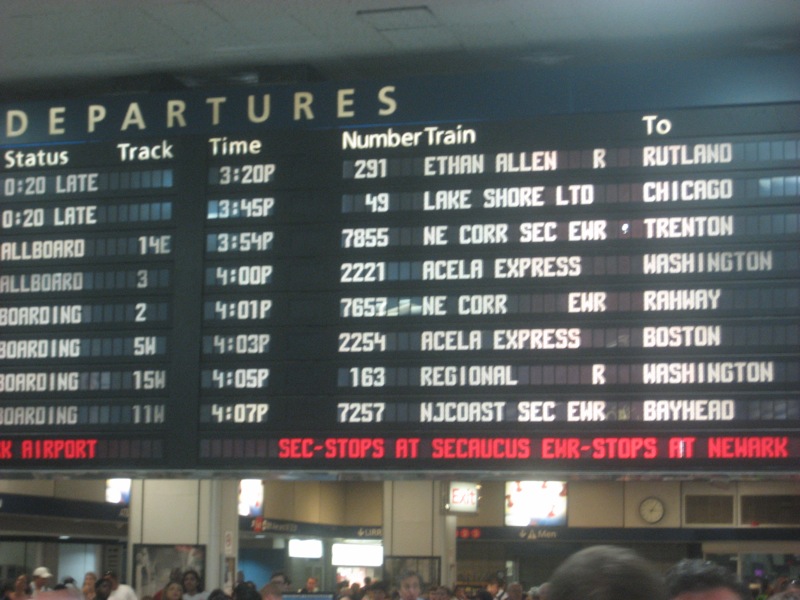
Coming home Sunday night from the final performance of Honk! (featuring Little Guy in his first lead, and Snuggler in a main character role) I had a mental image of the departure board at Penn Station, with the top listing flicking its way off and all the other train listings moving up a notch. It's not a bad analogy for my life at the moment. Dancer finished her first weekend of Nutcracker performances, and now has only four more to go (I work backstage for most of that). Eldest arrives home on Wednesday. Our annual cookie project is concluding, in which folks from the neighborhood bake cookies which then get delivered to the local food pantry. My mom arrived Sunday morning so she could see the musical; she leaves today, weather permitting.

Ten days (or departing trains?) ago, during my intense busy period of editing six masters' thesis proposals (which coincided with a quarterly project and a monthly project), Eldest hit a crunch: she had three huge school projects due and a trip to California for a job interview. It was an overwhelming to-do list even by my standards.

The situation looked impossible from every angle. Which, however, did not mean it was impossible. We tend to think things are impossible long before they are. And once we start to fear something is impossible, anxiety can easily take over space in our brains that could and should be allocated to actually solving the problem.

Sometimes fear is a bigger obstacle than the actual problem, because fear can paralyze. As soon as you are paralyzed, you can almost guarantee you won't get through whatever it is you have to do. Which is why I live by Winston Churchill's saying, "If you're going through hell... keep going."

I have a method for dealing with impossible situations: I call the Green Blocks approach to life. When my kids were little and made a mess, saying, "Clean up this room!" was less than useless, because the directive was too overwhelming. So instead I'd say, "I need you to pick up all the green blocks." That narrowed the project down to one thing to focus on, and made it do-able.


After the green blocks were put away, we switched focus to the yellow blocks. Then the red blocks. The idea was to do one thing at a time. Whatever was next wasn't even on the to-do list until the first task was done.

In a way this is the antithesis of multi-tasking. Do one thing, and do it with 100% focus and effort. You will have more brainpower to put into it, and you will make progress. Then the problem becomes smaller.

*         *         *          *


Worries will creep in anyway, of course. I manage that by setting a specific time when I will allow myself to worry about the next thing. Maybe it's two hours away, or maybe at 8 p.m.  As I told Eldest, it's okay to set aside a worry for a while -- it's not as if it's going to go away if you put it down. When your allotted time for the task at hand is up, you can pick up the worry again... if you want to.

*          *           *          *

When you were a kid, hyperventilating at a page packed with 50 math problems, hopefully your teacher showed you how to put a sheet of blank paper over all but the first line, so the task wasn't so overwhelming.

As adults, we sometimes forget that we can still take this approach to big problems. The more successful we are at developing techniques that keep us from becoming overwhelmed, the more likely we are to succeed in getting through the big things. 

You can only do what you can do. Then again, you can do far less when you're feeling overwhelmed. You can do far less when you're worried. You can do far less when you're floundering or running in circles. 

Even if all you can do is put away the green blocks at the moment, do it. If you can't pick them all up, pick up five. Then pick up five more. Or map the number that you pick up to the digits in your phone number (e.g., first pick up 2, then 1, then 2...)  It's not nearly as hard as trying to pick it all up at once.  


Friday, November 29, 2013

Choral beauty

Eldest came home late Wednesday night and left for college again this evening. She's flying out to California on Thursday for a job interview on Friday, then back to school on Saturday in time to perform in her choir concert. In between now and then, she has to work on three projects due by the end of the following week. It's... a lot.

This morning, in order to capture a bit of one-on-one time, she and I walked up to the Cloisters. There's an 'exhibit' there through December 8th which, if you are anywhere in the NY area and can carve out a visit, is worth hearing. It's a sound installation in the Fuentaduena chapel of Thomas Tallis' 40-part motet, Spem in alium. There are 40 speakers, one for each voice.  It's quite breathtaking.

In addition to the experience of being in the midst, the middle, the center of glorious music, there was the magic of watching people listen. It's a holiday weekend, and although Eldest and I timed our visit to arrive shortly after the museum opened, the chapel was packed. I would guess there were 150+ people in the small room. A third of them stood motionless, eyes shut. Many others looked off in the near distance, lost in thought or emotion. No one spoke. No one texted. A few people took photos of the crucifix hanging from the apse.


When you are at a concert, you are the recipient of music. This is a different thing, a being-in-the-midst. When you are at a concert, you next to or in front of or behind others, and do not see how they are responding. To be lost in beautiful music along with others who are lost in it as well -- perhaps in the same way as you are, perhaps not -- is an interesting experience.

I did not see a single person leave during the entire 11-minute duration of the piece.

If you go during the week, it will not be as crowded. And the museum is now open on Mondays. The suggested admissions price is just that: suggested. They will not ask how much you want to pay at the desk, but if you say, "Two, please," and hand them two dollars, they will give you the tickets. (This is true at the Metropolitan Museum of Art as well, and at the American Museum of Natural History.)

Go. It is a beautiful thing to be among others who are appreciating a beautiful thing.

Friday, November 22, 2013

Social responsibility

I was at a social event a while back, outside of my neighborhood, with people I sort-of know but don't know well. It was a small gathering.

At one point I was talking about Eldest and her job search (she's a senior now), and how she wants to put her computer science degree to use in a position where it would make a difference in the world. She's not interested in working in finance, and not interested in start-up shopping services, and not interested in designing violent computer games. She's looking at companies at the intersection of computers and education, and at firms that build computer games that improve health outcomes, and at places that make applications to accelerate relief services after natural disasters.

One of the women turned to me and asked, "How do you teach a kid that kind of social responsibility? Kids feel so entitled these days!" Then the doorbell rang, so I didn't get to answer.

*        *         *         *

Had I had the chance to reply, my reply would have been, "You can't teach social responsibility... you have to live it." I would have also said that there's no guarantee. I don't know what proportion of what parents teach their kids gets tossed out; I've always guessed it's about 30%. It's probably a different 30% for each kid, too. Kids make their own choices, and some of them will end up having values very different from ours.

All we get to choose is the input. This one of the things I think many parents struggle with mightily: even if we do it all "right", at best we influence rather than control the outcome.

We're also notoriously blind to our sins of omission. What we teach our kids consists not only of what we say is right and wrong, but by what we show them. We can assume our children know we believe we should take action to alleviate human suffering, but they don't see what happens in our heads. They don't even see the check we put in the mail for typhoon relief. If we remember to tell them about the check, we forget that they don't necessarily know a) the thought process that went into our decision, b) whether the amount we sent constitutes a real sacrifice or simply an allocation of funds, or c) what our role is in alleviating suffering in the world.

We may forget to talk about how suffering is a constant for many people, not a weather-driven exception. We may forget to muse aloud about how hard it is to remember that others suffer, and how hard it is to remember -- in the midst of thinking about what we'd like to eat for dinner -- that we are the means of making the lives of others better.

When someone else's extreme suffering intrudes on our feelings, we have social sentiment. Social responsibility is what we do day in and day out.

*         *          *         *

I think it helps not to have extra money to donate to causes. Kids, after all, learn by doing, not by writing checks.

They learn by shopping for the food pantry ("Let's buy the good stuff, because think of what a bummer it would be if you had to go to the food pantry for Thanksgiving dinner supplies. And think how happy you'd be to see something really yummy in your bag!")

They learn by coming with you when you deliver the meal to the mom with a newborn. ("I betcha Sam's mom is exhausted. So I made them supper to make her day a little easier.")

They learn by having to deal with your absence when you're at a community board meeting, or when you shlep them along to put up fliers for an event, or when you send them on an errand to help a neighbor.

The main thing is that they get the picture by connecting the dots... and there have to be a lot of dots for the picture to make sense.

Friday, November 8, 2013

Monday, October 28, 2013

Bad tooth, redux (and resolved)

I headed to the dentist this morning, to have That Tooth extracted. You know the one: the last time they tried to get it out, they broke my jaw, instead.

I got a letter from my insurance company last week saying it won't pay for the previous "extraction", because the dental school hasn't sent them any documentation. Hmmmm. I think one of three things happened: 1) the dental office didn't send documentation because the tooth is still in my mouth, 2) the insurance company has cut back on file clerks, since they'd just assured me last week that they'd reviewed my dental records and there'd been no malpractice, or 3) someone's out to make me crazy.

*        *         *        *

The resident came in and was puttering around. My dental student -- who was going to be observing -- got things ready. The two chatted a bit. The dental student had already shot me full of numbness, and was beginning to put the nitrous oxide to my nose when I stopped her. "He's not going to touch me until he has the decency to introduce himself," I said firmly. Startled, he did.

This is one of the advantages of middle age: if someone younger than you is doing something that's just plain wrong, you have few qualms about saying so. A decade ago I wouldn't have spoken up.

*         *          *          *

It took longer to extract than you'd expect. I thought a lot about how much worse it would have been a hundred years ago, or if I lived in the third world today, or if someone were doing this to me as part of an human experiment during WWII. I offered up whatever suffering I might need to endure, asking that it might be used to alleviate the suffering of others who are undergoing worse pain, including our friend Ken, who is undergoing a major procedure today.

It wasn't too bad -- except when the dentist was twisting a piece of the tooth and I could feel the pressure. Then I had to consciously relax my muscles again and again, and let the process be what it was: scary. It was during a moment like that that my jaw had snapped.

After it was over and I was stitched up, my student dentist asked gently, "How are you now?"
"Not as scared as I was!" I replied.
"Me either," she admitted, "I was praying the whole time!"
"Me too," I said.
"This is a bad memory that will stay with you a long time," she said ruefully.
"Naw," I said, surprising even myself, "The only thing we need to remember about hard things is that we got through them. Learn what you can, and be glad it's over. We'll both be okay."

*         *          *          *

All that said, I'm feeling pretty proud of myself. And sore.


Tuesday, October 22, 2013

Miscellaneous thoughts on miscellaneous feelings

Yesterday I took Dancer to a doctor's appointment. It was at a clinic that's only open in the mornings, so she had to miss school. The clinic, of course, was slow. We needed blood work done. Then I discovered I didn't have Dancer's insurance card, which was okay for the clinic but not okay for the lab. As my brain scrambled, I talked out loud, trying to figure out how to come back without having Dancer miss another morning of school. My daughter said, "Mom, calm down!"

I didn't think I was all that agitated, but then self-perception isn't everything. Sometimes what matters is how your kid perceives your level of worry.

*         *          *         *

Long ago I gave my kids permission to tell me to stop if I start to rant. They do this. It helps. There are occasions when I get going and have a hard time stopping, but to have a kid comment, reasonably objectively, "Mom, you're ranting!" does tend to put a cork in it.

There are better ways to express frustration and anger than ranting. They're not easy to think of in the moment, but if someone points out what you're doing (and you don't want to be a ranter), you can usually hold it in until you think of a better way to handle your feelings.

*        *         *         *

I hate nagging. To my way of thinking, to nag is the same as to take on the role of being someone else's frontal lobe. I don't want that job. I want others to have their own, functional frontal lobes. I am willing to prompt my kids. I am willing to remind them once, maybe twice. I am willing to work with them to help them figure out how to remind themselves. But I get annoyed if I have to nag.

I would buy supplemental frontal lobes if they sold them, like external hard drives. Wouldn't that be awesome?