Thursday, December 10, 2009

When you don't have a magic wand


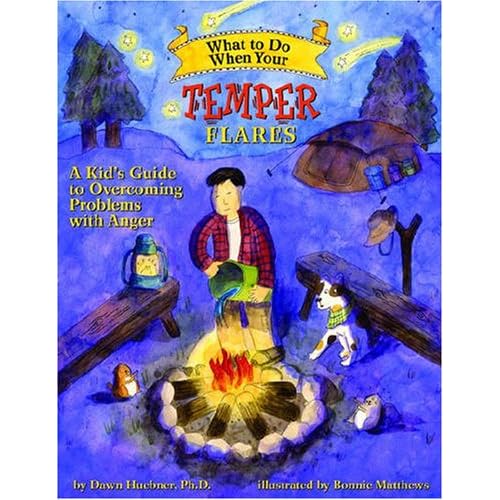
I like this series of books. We have three: What to Do When You Worry Too Much, What to Do When You Grumble Too Much, and What to Do When Your Temper Flares. There are others in the series, including one for OCD, one for breaking bad habits (nail biting, thumb sucking), and one for sleep issues and fears. For about ten bucks (through Amazon) you get a couple thousand dollars' worth of therapy, though without the personal touch.

The books are written for kids to read and work through, and they're very engaging. It helps to have Mom or Dad there to snuggle up with, though. And the techniques take practice if they're going to be instilled deeply enough to work.

Tuesday, December 8, 2009

Efficiency and Stress

It's 6:59 as I start to write, and cinnamon muffins have been baked, one kid is out the door, and I've already finished proofing the piece that's headed to the printer this afternoon. That's good, because if I told you everything that has to happen between now and 10pm you'd tell me I'm crazy. The two big things this evening are that Dancer has tech rehearsal, and I have to run a dinner for 225-250 people at Eldest's school.

I'm not an efficiency expert like the dad in Cheaper By the Dozen. I've noticed over time, though, that I am more efficient when I am not stressed. My brain is better at finding solutions when I don't worry about how (or if) I'm going to come up with an answer. Several years back I hit on something that revolutionized my life: I realized that logistical problems belong in the puzzle-solving part of my brain, not in the worry center. When I treat them like crossword clues I can't quite get, leaving them alone while I work on another part of the puzzle, then coming back, I make surprising progress.

I have a lot of logistical issues in my life. There's a 90-minute gap today between when I leave to take Dancer to tech and the time Dancer's godmother can arrive to take care of Little Guy and Snuggler. The younger kids are going to a friend's concert this evening. I can't take them with me to drop off Dancer, because there isn't time to get home again before I have to be at the school.

Frankly, no one is going to die or be inalterably damaged if I don't figure out a graceful solution to this. [Key point: life is easier when we stop equating solution with good solution. There's a whole spectrum of solutions, and if we're willing to entertain them all we come up with something that works more quickly.] At worst, the kids don't get to go to their concert, the friend they're going to see is disappointed, and my guys sit around cranky and bored at Eldest's dinner. But no: it's worse if I freak out, act irrationally with my kids because I'm stressed, put them on edge, and trigger misbehavior and neediness. That actually can damage kids and relationships, and have a long-term effect.

I know that most of the time when I do stress out, it's because I feel trapped. I'm stuck in some way, can't see an immediate escape path, and don't think I have the time or resources to get out gracefully. Then I remember the basic test-taking strategy of setting aside the problem and going on to the problems I can solve. I can always come back, no? Usually when I do (and especially if I've used the intervening time to get other things off my plate), my brain is clearer and the answer is easier to see.

Sunday, December 6, 2009

Making progress

I went to a meeting at Big Guy's school on Thursday. Although the topic was how to find the right high school for your child, the announcement called the meeting Discharge Planning. Big Guy attends a therapeutic day school; he has a severe anxiety disorder.

Sitting in the school cafeteria the other night was the first time in the past seven years that I have been among other parents who have been through what we've been through. The social worker who led the meeting said, "Virtually all of you have gotten here the hard way." The daughter of the woman next to me has been hospitalized three times in the past two years. Big Guy has had extended hospitalizations twice, once at age seven and once last year. We've been to the ER many times, and had to call 911 many more. Having to call 911 on your own child sears the heart and bleeds the soul. You get better at it with time.

The social worker commented, "You've had to deal with the difference between the child you thought you had, and the child you were given," and we all nodded. I don't know the diagnoses of the other children at the school, but they range from being on the autism spectrum to early onset bipolar disorder and other severe mental illnesses. These parents have had it rough. There was one woman who said she has four children, two of whom are in residential treatment. I can't imagine that; it's a layer of hell I didn't realize existed.

Big Guy is new to this school, having started in July. His previous school was a cinderblock building in the middle of a treeless section of the city, a place that was all justice and no understanding. At least half the student body was there for behavioral problems, not emotional ones. The city mixes the two, as if it's not sure what the difference is. When we were looking at new schools last year, one administrator explained that because of budget issues the kids who get placed in private schools are increasingly the ones with behavioral problems. If a child has an emotional disorder that causes him to sink quietly, the school system will allow that to happen. If the child is interfering with the rest of the class, the system will find a way to remove him.

Big Guy's old school wasn't quite Dickensian, but no one ever returned to the mainstream from there. We visited schools that were worse, including one where the admissions officer told us cheerfully, "Things are a lot better since we stopped admitting so many gang members." Still, Big Guy had to deal with things at his school that would have made even a healthy person anxious. If we hadn't succeeded in getting him out of there, I do not think he'd still be with us today.

This new school is wonderful. It's beautiful, with over a hundred acres of greenery, paths in the woods, and a horticulture program. The staff are superb. They are caring, insightful people who truly seem to be able to work with Big Guy and make progress. Big Guy is happy, and he's working hard.

The school goes through ninth grade. My big question on Thursday was whether it's harder to get into a therapeutic high school if you apply in 8th grade or 9th. Thankfully, there's no difference. We can keep Big Guy at this school for another year. Deo gratias.

Friday, December 4, 2009

Sometimes when it feels like your life is falling apart...

It is.

Two days ago, just before the light switch in the big bathroom blew ("No, you don't need to see in order to pee. Just go."), I put Little Guy in the tub. Oddly enough, the 1934-era drain didn't seem to be plugging up the water. I jiggled the handle (it's a long, tube-like thing), and it came off in my hand. The pipe had broken clean at the bottom.

The plumbers arrived today. Yeah, plumbers! Well... let's dampen that enthusiasm a bit. They came.


They destroyed.


They left.

They say they'll be back in a few days. But at least the tub and shower are usable again. And the super fixed the light switch, so next time the plumbers won't be working in the dark.

Thursday, December 3, 2009

On Beyond Porcupines


I came home from a meeting last night with this observation: prickly people get under your skin, but toxic people poison the social environment.


Fortunately there aren't a lot of toxic people in the world. You know'em when you meet'em because:


1. The underlying message they send is You don't matter. What matters is what I want and you have no right to get in my way.

2.  Cues and verbal intervention directed at stopping the behavior are ignored.
3. Although you may have profound respect for other people in the room, you leave feeling you never want to go back there again.
4. Everyone involved ends up feeling unclean and soiled (not to mention insulted and angry).

How does one deal with a toxic person (TP)? I think there are a couple of approaches. The first order of the day is to operate at a safe enough distance that you are not sucked into acting the same way. I find I have to consciously tell myself I do not want to be this person. I have to remind myself that I don't want to live in the darkness that person casts; I want to live in the light. I can't fight on their turf. And I have to find the distinction between venting and gossip, letting my feelings loose only with those who can help me heal, and keeping my mouth shut when the only possible outcome will be to re-ignite my indignation or to inflame others.

The simultaneous, almost-goes-without-saying thing to do is to make sure the TP doesn't know how you feel about him or her, so you avoid becoming a target. I lucked out last night because the TP was so absorbed in her tantrum that she didn't notice the gaping look of horror on my face.

Within the parameters of keeping yourself safe, you can develop a plan of action. Last night's situation had a relatively straightforward next step, because this TP has a boss. I sat down to write the boss an email, and it took me well over an hour to write four short paragraphs. To be effective, I knew the letter had to be about the problem, not about my feelings about the problem. I'm slow: it takes me a long time to figure out exactly what I want to say, and then dozens and dozens of drafts to extract the emotion. As a final check I passed the letter by Andrew before sending. He found a few more things that he thought it would be better to leave out.

The letter's done and sent, and now there's one more thing to do. When someone depletes the world of good, one thing I can do is try to add a bit more back in.  That's my project for the day.

Wednesday, December 2, 2009

Porcupines

Yesterday on the subway en route to swimming, Little Guy was telling me about a kid in his class who was getting on his nerves. I could tell this was heading into a rant, so I stopped the tirade with a shrug and my by-now stock comment, "Hey, everywhere you go in life there's going to be at least one annoying person."

The people surrounding us laughed out loud. Guess they'd never thought of it that way. But what are the statistical odds that in any given group of people every single person is going to be pleasant? Life's a lot easier when you assume that there will always be someone in the room you'd rather not have to deal with.

I once saw a book in a catalog called How to Hug a Porcupine. I love that title. I've remembered it for over a decade, though I never read the book. There are almost always ways to get along with prickly people safely. The key is remembering that the goal is to get along with them, rather than make them go away. (Once in a while distance really is the best solution. But not always.)

Like many people, I have occasional quill-like tendencies. As a young adult, I congratulated myself on having blunted most of them. Then I had kids, and discovered I have more prickles than I'd previously imagined. Kids'll do that to you: reveal your flaws. It's one of the good things about having children.

Tuesday, December 1, 2009

Bad luck, good people


We were slated to go see the Magna Carta today. It was a homeschool group trip, so we headed to the subway at about 9:00 to allow ample time to get there by 10:15. The train went one stop and promptly... stopped. It stopped for a long time. At first we were told there was an emergency a couple of stations ahead (I'm okay with emergencies; a heart attack takes precedence over my field trip any day), but then it turned out to be the usual train with mechanical difficulties. I always think that description sounds a bit like it belongs in an IEP or something.

As the minutes ticked and ticked and ticked past, it soon became clear that our chances of getting downtown in time were going to be small. We were all sad. The kids kept asking if we'd make it, and sometime after we finally started moving again I looked at the time and said, "No, we're not going to get there before they start." When we emerged from the train, still a 15-minute walk from our destination, it was 10:42. Pooh.

I was all for going to Plan B (whatever that was), but Snuggler was indignant. "We can't give up without even trying, Mom! Can't we try?" I hadn't known the Magna Carta meant so much to her. I hadn't even been sure she knew what the Magna Carta was.

So we meandered a bit further south, looking at other good and interesting things on the way. It started to rain. We headed toward the museum, mostly just to show the kids where it was and what it looked like. As we approached, Dancer said, "Hey, look! There's our group!" They'd just come out of the tour.

I crossed the street to proffer my apologies for our absence to the woman who coordinated the trip. She said, "It was a great trip. But you know, the docent said that if anyone else from our group came and wanted to see the Magna Carta, they could. Let me check!"

There are some pretty strict rules on how many people can be in the viewing room at once, and unfortunately the last school group of the day didn't have room for four more people. The docent came back and said, "Oh, you really have to see it! So this is what we'll do. I'm going to assign you a guard, and you can go in the back way. You just take your time looking at the rest of the museum (which is closed to the public), and then when this group comes out we'll slip you right in before we close."

How amazing is that? There's someone in this big, tough world who wants as many kids to see the Magna Carta as want to see it, and who's willing to do something a little unusual to make it happen. So we had a private tour, and plenty of time, and then we had the Magna Carta all to ourselves.